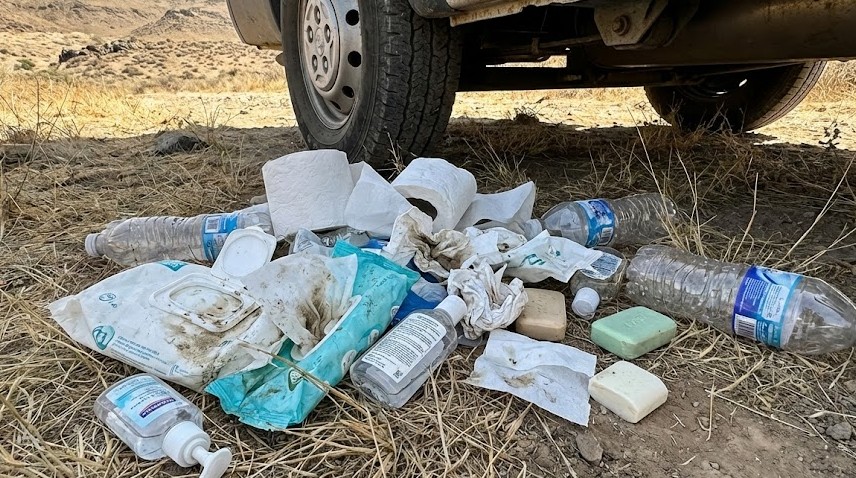
When cleaning up after a hike or a day on the road, most people reach for a wet wipe. But there is a massive amount of hidden plastic in wet wipes that remains invisible to the naked eye. You are essentially rubbing a disposable plastic sheet onto your skin. This invisible plastic pollutes our environment and fails to provide the high-standard hygiene your body deserves.
According to the Marine Conservation Society, dozens of wipes are found for every 100 meters of beach. The data is clear: 90% of wet wipes contain plastic resins such as polyester or polypropylene. They look and feel like fabric, but they persist in the environment for centuries, breaking down into microplastics that eventually enter the food chain.
Are wet wipes still useful?
Let's be honest: in a medical emergency in an arid zone, a sterile wipe remains a valuable last-resort tool. Its ability to provide immediate disinfection without complex logistics is its primary strength. We have all been in situations where water was strictly reserved for survival, making a single wipe a necessity.
However, for daily hygiene (vanlife, sports, changing diapers), this compromise is no longer justified. A wipe does not actually wash your skin. It moves dirt around and leaves a chemical film on the epidermis. This is where the mechanical approach must change to protect both the planet and your health.
The cost for your skin: the cocktail effect
Beyond ecology, the dermatological impact is significant. Unlike washing with water, using a wipe does not involve rinsing. You are leaving a mixture of preservatives, surfactants, and synthetic fragrances on your skin. As someone who has spent months living in a van, I have seen firsthand how this leads to chronic irritation.
A study published on NCBI highlights the importance of the skin microbiome. Repeatedly using wipes without rinsing can disrupt your natural pH and weaken the protective barrier of the epidermis. Pure water remains the most neutral and effective solvent for human skin.
The winning ecosystem: Pressure + Textile
A common question we hear is: "Why not just use a water bottle and a washcloth?" This is an excellent point. A washcloth is an ecological solution far superior to a wipe. However, it lacks a key element: water management. Having tested various prototypes in the field, we know that pouring water from a bottle onto a cloth is imprecise and wasteful. The cloth absorbs too much water before it even touches your skin.
Rinsing that cloth without a tap is even more difficult. This is where the PORTALO comes in as the missing link in your outdoor kit.
By propelling water under pressure, it allows you to:
- Imbibe the textile instantly with very little water.
- Rinse the washcloth effectively after use thanks to the kinetic energy of the jet.
- Wash sensitive areas directly with the spray, avoiding unnecessary friction.
The PORTALO does not necessarily replace your washcloth. It transforms it into a fully functional, autonomous washing station that works anywhere, from a mountain top to a highway rest area.
Comparative Analysis: Efficiency and Residue
| Criteria | Standard Wet Wipe | Portalo (+ Optional Cloth) |
|---|---|---|
| Mechanical Action | Friction (spreads dirt) | Pressure (evacuates dirt) |
| Skin Residue | Chemical film | Zero residue (pure water) |
| Waste Impact | Plastic (450-year lifespan) | Durable (reusable) |
| Logistics | Storing dirty waste | Autonomy (any water source) |
Outdoor Hygiene: Your Questions
Is a washcloth not enough by itself?
A cloth is great for scrubbing but poor for rinsing. Without running water, a cloth quickly becomes a breeding ground for bacteria because it cannot be cleaned properly. The pressurized jet from the Portalo lets you rinse your cloth (and your skin) as if you had a tap, using only a fraction of the water.
How do you get pressure without batteries?
It is pure physics. An integrated micro-pump compresses the air inside the reservoir. A few pumps create enough kinetic energy to propel a constant jet. No electronics, no charging, no failures in the wild.
Does water alone clean better than chemicals?
The jet physically removes sweat and salt without irritating the skin. For a deeper clean, combine the pressure with Aleppo or Marseille soap: these 100% natural options are compact, antibacterial, and biodegradable, offering a healthy alternative to the synthetic fragrances found in wipes.
The end of the "trash bag chore"
Carrying a bag of used (and smelly) wet wipes in your backpack or van is a major logistical hassle. Since burying them is forbidden due to their plastic content, you must pack them out. With a water-based solution, you are free as long as you can find a stream, a lake, or a public tap.
Switching to pressurized hygiene is more than just a gesture for the oceans. It is a choice for consistency. You no longer need to depend on an industrial consumable for a natural biological need. By eliminating the need for wet wipes, you simplify your gear and your environmental impact.
"True cleanliness leaves no trace. Not on you, and not in nature."
Ready to lighten your pack and your footprint? Discover the Portalo solution.