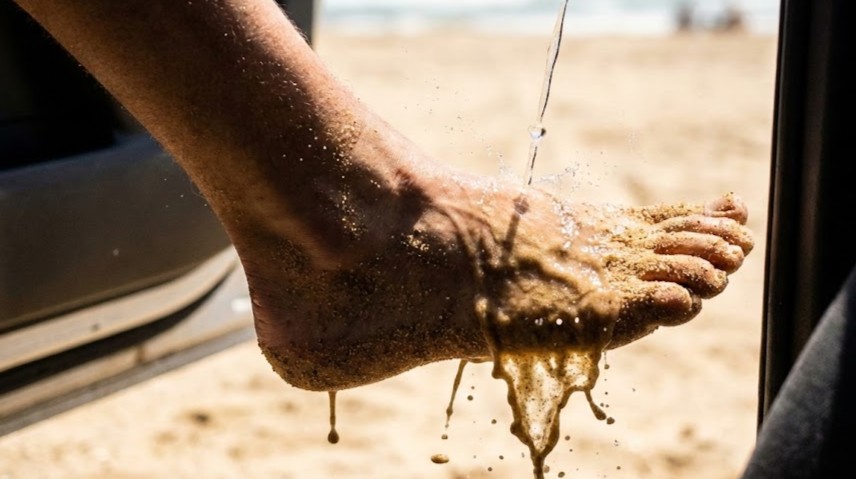
After a surf session, a coastal hike, or simply an afternoon with the family, returning to your vehicle is always the moment of truth. Sand, that idyllic seaside companion, becomes a real nuisance the moment it crosses your car's threshold. It gets into the carpets, jams seat sliders, and invariably ends up in your bed if you live in a van.
At Portalo, before drawing a single prototype, we spent an entire summer testing "old wives' tales" and commercial accessories. Our goal? To understand why, despite all the existing solutions, we always ended up with two pounds of sand in the car. Here is the report of our findings.
The comparison: what we tested in the field
In our experience, no method is totally useless. They simply have limits that we wanted to map out in order to design a tool that finally ticks all the boxes.
| Tested Method | Strong Point | The "Breaking Point" | Car / Van Impact |
|---|---|---|---|
| Talcum / Powder | Effective on dry skin | Useless on wet or salty skin | White deposits on pedals and carpets |
| Dedicated Brush | Cleans shoes well | Difficult to clean the brush itself | Residual sand in the bag |
| Water Bottle | Free and simple | Huge waste for little result | Mud puddles under your feet |
| Plastic Bag (TikTok) | Fun (at first) | Fragile and polluting | Unusable on the rest of the body |
| Portalo (Jet) | Total efficiency | Needs to be filled | Zero residue, car interior preserved |
Why traditional methods left us wanting more
Talcum powder: a bad idea for your safety
Talc is often cited as a miracle cure because it has an undeniable advantage: it reduces friction, helping feet slide more easily into sneakers after the beach. But during our real-world tests, we quickly became disillusioned with the side effects, both for hygiene and safety.
On skin that is still damp or salt-laden, talc doesn't remain a fine powder: it turns into a sticky gray paste that crawls between your toes. Once behind the wheel, the situation gets worse. Talc is a volatile and extremely lubricating dust. By smearing your brake and clutch pedals, it makes them dangerously slippery under your soles. Not to mention the persistent white streaks that dull black plastics and cabin carpets.
Experience has also shown us that the problem follows you home. On smooth surfaces like tile or hardwood, talc turns your soles into literal ice skates for several days. Whether you're in socks or barefoot, the risk of a fall is real and persistent. It’s precisely these logistical details that pushed us to seek a clean, water-only solution.
The plastic bag: the "viral" solution trap
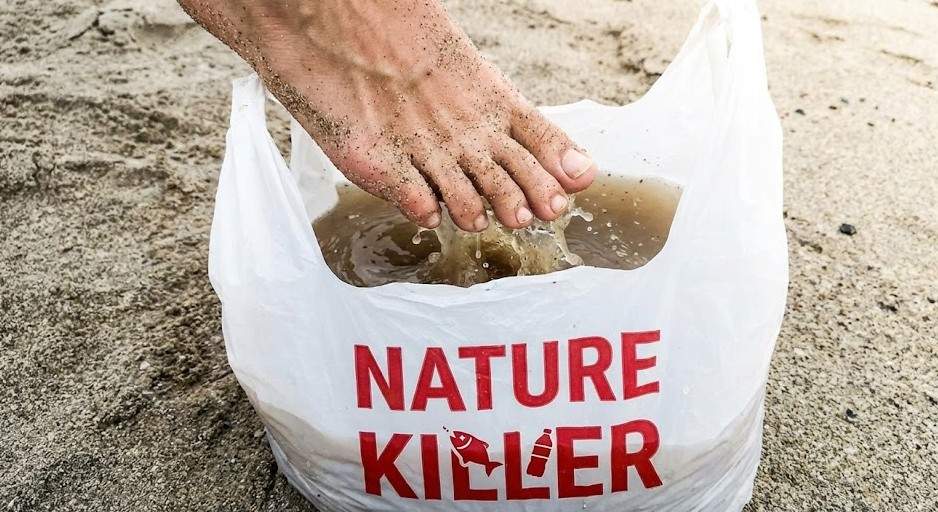
We've all seen it on social media: fill a plastic bag with water, dip your foot in, then pull it out "clean." In practice, it’s the textbook example of a solution that creates more problems than it solves. First, from an ecological standpoint, using disposable plastic for this task is absolute nonsense. But it's mostly its logistical fragility that poses a problem.
A plastic bag punctures easily. Carrying it full of water in your beach bag or car trunk is like playing Russian roulette with your dry clothes. Furthermore, the method is very limited: it doesn't allow you to rinse your calves, hands, or surf gear. The moment you step out of the bag, if you don't have a sterile surface to land on, the sand returns as soon as you touch the ground. It’s a vain effort that often ends up creating a puddle of stagnant water in your trunk.
The brush: the "cleaner-to-clean" problem
A brush is an effective mechanical tool for hard surfaces. But on the skin, especially after prolonged sun exposure, stiff bristles combined with sand can quickly become irritating and unpleasant.
Additionally, we noted a major logistical constraint: what do you do with the brush once the cleaning is finished? It stays clogged with wet sand between its bristles. If you put it back in your bag or glove box, it continues to shed sand everywhere it goes. It's an endless cycle.
The technical approach: beating adhesion with pressure
During our research phases, we understood a simple physical principle: sand doesn't stick to your skin by magic, but by surface tension (the moisture that acts as a "suction cup"). Pouring water from a bottle isn't enough to break this tension; it only moves the grains a few inches.
This is where engineering comes in. To dislodge sand without emptying a 10-liter tank, you need exit velocity. By concentrating a small volume of water (about 350 mL) through a pressurized jet, you obtain kinetic energy capable of lifting the grains instantly, even if they are embedded in skin folds or between toes.
Portalo: designed to solve every constraint
Rather than offering just another gadget, we designed Portalo by integrating all the lessons learned from our tests:
- To avoid waste: A precision nozzle that releases the exact amount of water needed.
- For vehicle cleanliness: A waterproof and compact format that fits into a cup holder without leaking, unlike a plastic bag or a dirty brush.
- For the skin: No mechanical contact, only the gentleness of pressurized water, ideal for children or sensitive skin.
- For durability: A manual system, without batteries or electronics, capable of withstanding salt and the heat of a car trunk in mid-summer.
Portalo: Targeted micro-hygiene expertise
Rather than offering another gadget, we designed Portalo to meet a specific need: micro-hygiene. It’s not a high-pressure cleaner for car bodywork, but a precision tool for your body and gear. Its 2-minute continuous jet autonomy is optimized for a full rinse without wasting your water reserves.
How it works in 3 steps:
- Fill: Use any fresh water source (tap, canteen, beach shower).
- Pressurize: A few quick manual pumps put the tank under pressure.
- Rinse: Release the jet for instant removal of residues.
The "Top-Down" method for perfect results
For effective cleaning, we recommend a downward routine. Start with the hamstrings, then move down to the calves. Pay special attention to the creases, especially the back of the knees (popliteal fossa), where sweat and salt often cause irritation. Finish with the feet and spaces between the toes. This method prevents dirty water from running onto an already rinsed area.
Portalo's jet is designed for precision: it breaks the surface tension holding the sand without spraying everything around you. This targeted efficiency is what allows you to clean yourself entirely with just 350 mL of water.
An investment for your entire outdoor life
Once the sand is tamed, Portalo becomes an everyday ally. Its robust battery-free design makes it a reliable tool for many other contexts:
- Daily hygiene: A pocket faucet for hand washing or personal hygiene.
- Canine hygiene: Rinse muddy paws before getting back in the car.
- Technical maintenance: Clean salt off your surfboard fins or dust off a bike derailleur after a ride.
- Nomadic life: Spare dishwashing in a van.
If you want to delve deeper into the subject and understand why precision beats raw flow, check out our complete comparison of portable showers and mobile hygiene.
"Efficiency is not about the quantity of resources used, but about the precision of the action."
Ready to change your post-beach routine? Explore the Portalo solution.